 Jump to recipe
Step-by-step Guide to Reactivating Your Dehydrated Living Sourdough Starter Culture

Welcome to your step-by-step guide on how to reactivate a dry sourdough starter. The whole process takes just under a week, but is very easy to do! By the end, a small bit of dry sourdough starter powder will transform into a voluminous, bubbly, active sourdough starter – ready to bake with. With a little love and weekly care, one sourdough starter will provide you with years of delicious, nutritious, and rewarding sourdough baking at home.
If you bought your dehydrated organic sourdough starter from us here at Delgado Homestead, thank you! The process explained here will work to reactivate any dehydrated sourdough starter – though you may need to tweak the water ratios a bit, as explained in the consistency section below.
Jump ahead to the end of this article to get a printable, condensed version of these instructions. Once you complete the sourdough starter activation process, head over to our ongoing sourdough starter feeding, maintenance and storage guide.

What is a dry sourdough starter?
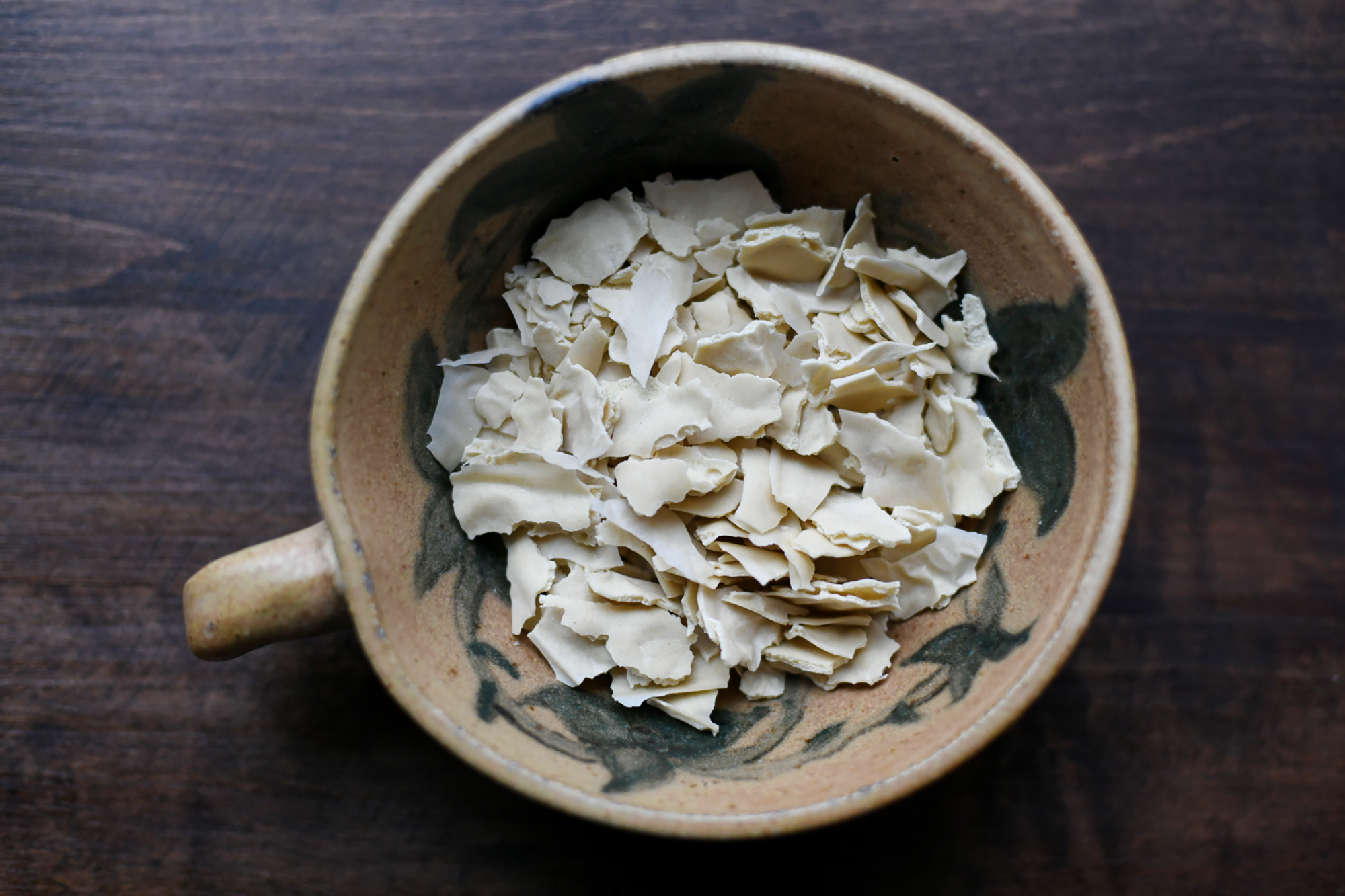
Dry sourdough starter is made by dehydrating a portion of an active, healthy sourdough starter. When we dry our organic starter, we do so on a very low “living foods” setting in a food dehydrator. This preserves the beneficial lactic acid bacteria and wild yeasts that are inside the starter. They are responsible for making a sourdough starter bubble, and sourdough bread rise. The dry starter is still very much alive! It is simply in a dormant state and needs to be reactivated.
Using a dry sourdough starter is a great way to kick-start your sourdough baking journey. It is almost fool-proof! We created our original sourdough starter from scratch. Most people find that process to be pretty straight forward, though it does take more ingredients to get going. Some people have struggled to make a starter from scratch, and ended up with either moldy or non-active starters. By using a dry sourdough starter, you’re working with a healthy established culture from the start.
How to Reactivate a Dry Sourdough Starter
Your powdered dry sourdough starter needs to be rehydrated and fed to feel alive once again. The colonies of lactobacillus and yeast within the sourdough starter feed on starches in flour. However, you can’t simply mix a little dry sourdough starter in with a large bowl of flour and water. Too much flour and water will overwhelm the dry starter at first. She isn’t strong enough for all that yet. Rather, we need to start small and slowly build up the volume of starter, flour, and water gradually. That is why the process of reactivating a dry sourdough starter usually takes about a week. The final result will be several cups of active starter!

Before we get into it, let’s go over a few tips and expectations.
Consistency
These instructions were developed using Delgado Homestead’s Fiona dry sourdough starter culture. They will work with other other dehydrated sourdough starters, though the measurements and consistency may vary slightly depending on the particular dry sourdough starter you use. Every individual home environment (e.g. different elevations and humidity) could also lead to some variations.
No matter your starter or home environment, the goal throughout this process is to maintain a thick gooey starter. It should settle smoothly into the bottom of the container (meaning, not clump into a firm ball of dough like cookie batter) but it shouldn’t be easy to pour or runny like pancake batter. The sourdough starter should be somewhere in between. Eventually, an active sourdough starter will be fluffy and spongy.
If at any time throughout this process you feel that your starter has become too stiff or too thin, feel free to add a sprinkle more flour or splash of water until the desired consistency is reached. Do so in small quantities, such as a teaspoon at a time (especially in the first few days).
Temperature
The beneficial bacteria and yeast that live in your sourdough starter are most happy, active and balanced in a temperature range of about 70 to 75°F. Cooler conditions will lead to slower activation and a generally less vigorous starter. Warmer temperatures may make the process go faster.
It is okay if your house is cooler or warmer than “ideal” – just keep in mind that it can lead to a slightly different timetable and starter behavior than shown here.
Timing
To reactivate your dry sourdough starter, you are going to need to feed it once per day for the duration of about a week. It is best if the feedings occur about 24 hours apart, though it doesn’t need to be exact. Choose a time of day to start that you’re usually available and will be easy to remember.
Once the starter is reactivated, it won’t need daily feeding (unless you choose to store it at room temperature). We store ours in the refrigerator and only take it out to feed/bake on the weekend.
Let’s do this!
SUPPLIES NEEDED
- 1 package of dry sourdough starter powder or flakes (approximately 1 heaping half-tablespoon)
- All purpose flour or bread flour. We have experimented with reactivating a dry sourdough starter with both types of flours, and it works perfectly with both. Note that we use certified organic flour, which the microbes generally prefer but isn’t absolutely necessary. If you’d like to transition your starter to whole wheat or rye in the future, you absolutely can! However, I suggest using simple white flour when first reactivating the dry sourdough starter.
- Filtered water or spring water. Ideally, the water used to activate and maintain a sourdough starter is free of chlorine.
- A pint size mason jar (or similar). Given the small volume, you can start the process of reactivating your dry sourdough starter in an average jar, glass, or other similar size container.
- A larger glass storage container. On day five of this process, we will transfer the activated sourdough starter into a larger container – its forever home! We use this really cool gizmo called a Goldie by Sourhouse. It keeps the starter at the perfect temperature and you never have to worry about it being too cold or too hot in the house.
INSTRUCTIONS
Day 1
- In a clean pint-size mason jar or similar, combine one full Delgado Homestead package of Fiona dry sourdough starter (approximately 1 heaping half-tablespoon) with 1.5 tablespoons of filtered lukewarm water. Avoid using cold water throughout this process, as it will slow down the activity of the starter. Allow the dry sourdough starter and water to sit for several minutes to soften and combine. Use a fork or spoon to stir it on occasion.
- Then, mix in 1 tablespoon of flour. Mix thoroughly. Try to avoid making a huge mess of the sides of your jar. Use a small spatula to clean up any hefty smears.
- Cover the jar with a lid. It doesn’t necessarily need to be air-tight; the purpose is to prevent it from drying out or allowing mold spores in. I only lightly screw on BPA-free plastic jar lids. If you’re using a drinking glass or other container that doesn’t have a lid, simply set a plate on top, add plastic wrap, or a reusable beeswax wrap on top.
- Finally, set the container in a moderately warm location. Come back in about 24 hours.
Day 2
Into the same jar as yesterday, add 1 tablespoon of flour and 2 teaspoons of water to the starter. Mix well. Cover the jar or container again, and allow it to sit for another 24 hours.
Have you thought about a name for your sourdough starter yet? There is a tradition in the sourdough baking world to name your sourdough starter. In fact, it is considered bad luck if you don’t! Today sounds like a good day to pick a name.
Day 3
By day three, you may start to see fermentation bubbles in the starter! Repeat the same process as yesterday, adding 1 tablespoon of flour and 2 teaspoons of water. Mix, cover, and set aside.
During the next 24 hours, your starter may start to rise. Just for fun, mark the level of the starter on the side of the container after mixing (either with a washable glass marker or with a rubber band around the jar) and watch how much it rises.
Day 4
Today, we are going to step up the volume more than before. The growing sourdough starter should smell really nice by now, like sourdough and yeast – reminiscent of a brewery or bakery! That is an excellent sign she is getting stronger and can handle more food.
- This time, add 1/3 cup flour and 1/4 cup water.
- Mix well, until it looks like most of the flour clumps are broken up and the starter is fairly smooth.
- Cover the container, note the level of the starter on the side of the container, and set it aside again. If you’re using a pint jar, it should be about ⅓ full now.
Within 12 to 24 hours, your starter should bubble, rise, and nearly double in size! If your starter doesn’t appear to rise at this stage, see the troubleshooting notes at the bottom of this article. You may need to adjust your consistency, but it doesn’t mean the starter isn’t alive! If it is too runny, it won’t rise well. Different types of flours, humidity levels, and even measuring spoon sets can lead to some variation between our starter consistency and your own.
On the other hand, if your starter doubles in size and then quickly falls back down to the original starting point, you can move on to the next step sooner if you wish. That is a signal that she is getting hungry. (Smears on the side of the container are a sign that it rose and fell.) For example, if you added flour and water in the morning, it rose by midday, and fell back down by the evening – you could do the next feeding that same evening. Or, simply wait until the next morning. Either way is fine.
Day 5
If your starter is now actively bubbling, rising and falling – congratulations! You have successfully reactivated the dry sourdough starter. When a starter rises to double its size and then stays elevated, that is considered “peak activity”. Technically, it is ready to bake with at that point! However, at this stage in our reactivation journey, we don’t have quite enough volume for ongoing baking and maintenance. Every time you bake sourdough you must leave behind at least a half a cup of starter to feed and continue on. Therefore, we need to add a bit more bulk to the starter, and also move it into a larger container – her forever home.
- Transfer your starter from the mason jar into a clean mixing bowl.
- Now, add 1 scant cup of fresh flour and 1/2 cup of filtered lukewarm water. These measurements are approximately equal weights of flour and water in grams, which is the recommended flour-to-water ratio for ongoing starter maintenance.
- Mix well, and then transfer the starter into a new larger container of choice. Set it aside at room temperature once again.
Choosing a final storage container:
We like to store our sourdough starter in a flip top 1-liter glass container (34 ounces) or a 1-liter Goldie by Sourhouse. It provides sufficient space for the starter to be fed and double in size, and it also fits well in our fridge. We only ever bake one sourdough loaf or recipe at a time, and most of our sourdough recipes call for about 1/2 to 1 cup of active starter on average.
However, if you plan to make several loaves of bread or many sourdough goodies at once, you will want to use at least a 1.5 liter to even a 2 liter container and maintain a larger volume of starter than we do. You can always scale up later if you decide to!
*If you choose to use a larger container (1.5 to 2 liter) from the get-go, allow the starter to rise and fall once in the new large container. That will likely take several hours to one day. Then, feed the starter again in the same manner (1 scant cup flour and 1/2 cup water) to increase your overall volume once more before proceeding to the next step.

My sourdough starter is active! Now what?
At this time, I suggest you head on over to our article about sourdough starter ongoing maintenance. There, I go over the various ways you can feed and store your starter. A sourdough starter needs to be periodically fed. When it goes unfed, the starter will shrink down and eventually develop a layer of fermentation byproduct called hooch. That is a sure sign it is hungry. If enough time passes, a starved sourdough starter may die.
The feeding frequency depends on if you choose to keep your starter at room temperature or in the refrigerator. Maintaining a starter at room temperature requires significantly more work (and flour!) – as it needs to be fed once or twice per day! I would only recommend this for serious bakers who are using their starter many times per week. On the other hand, you can store your starter in the refrigerator like we do. Then, it will only need to be fed once every week or two.
If you get to the final step and aren’t sure how to proceed, simply put the active starter in the refrigerator for now.
Going forward
Clearly, you can’t infinitely add more flour and water to your container… the starter will quickly outgrow it’s home! In our starter maintenance article, you’ll learn a new style of feeding that is a bit different than what we’ve been doing to build up our starter here. Now when you feed your sourdough starter, you’ll almost always discard a portion before adding fresh flour and water. That may mean removing some to use in a recipe for baking, or simply removing some starter from the container to make space for more. The discarded portion can be used to make crackers or pancakes, fed to chickens, or added to a compost pile.
Transitioning your sourdough starter to a different kind of flour
If you want to feed your sourdough starter whole wheat, rye, or another type of flour, feel free to do so! In fact, many starters become even more vigorously active with wheat and rye flour. I suggest easing the starter into the change, by gradually adding the new flour type mixed with the original flour that it is accustomed to eating.
For example, if you’re currently feeding your starter all-purpose flour, try using 3/4 cup AP and 1/4 cup whole wheat for the first feeding, see how it responds, then increase to half and half, and so on with subsequent feedings.
TROUBLESHOOTING
My starter isn’t rising!
A couple of issues may cause a sourdough starter to not rise well. For one, it could be too cold in your home – though there should be at least some activity, even in the coolest conditions. A more common cause is the starter consistency.
Starter is too wet
When a starter is too wet or runny, the fermentation bubbles may rise right through and out of the mixture, rather than being trapped inside. The starter is very much alive, but doesn’t have enough structure to grow. If at any time your starter doesn’t rise and also seems easy to pour (like thin pancake batter), is it probably too wet. Stir in more flour to stiffen it up, adding just a few tablespoons at a time until it becomes more thick and gooey (but not a solid ball of dough). In a more stiff sourdough starter, fermentation bubbles become trapped inside the mixture, causing it to grow and become more spongy.
House is too cold
If your house is on the cool side, you could store your sourdough starter near a warm appliance, use an electric heating pad or seedling heat mat nearby (next to but not right against it – that would likely be too warm).
Last but not least, our favorite easy way to keep both sourdough starter and proofing bread dough warm during the cold winter months is to keep it inside the oven – with the oven OFF, but the oven light on! It creates the perfect cozy home. It if gets too warm in the oven, keep the door cracked open slightly. Remember to monitor temperatures in the area of the starter container with an ambient thermometer. We only do this when it is below 65°F in the house.
It is hungry.
Once your starter rises and falls, it won’t rise again until it is fed again. The yeast and bacteria within the sourdough starter colony can be self-limiting, and will only actively grow when there is “food” (fresh flour) left to consume. So, if it has been sitting out for a few days and it hasn’t risen yet, it won’t magically start doing so! In fact, if it sits too long it will develop a layer of fermentation byproduct called hooch, described below.
If your starter has seemed to stagnate, try discarding half of the contents in the container and then feeding it with a scant 1 cup of fresh flour plus 1/2 cup of lukewarm filtered water. It should perk back up! Then, continue to the ongoing starter care and maintenance instructions and either store it in the fridge or continue feeding daily.
What is that dark liquid on the top of my sourdough starter?
When the yeast in a sourdough starter has eaten up all of its available food and is hungry for more, it produces a thin dark layer of liquid on top. This is an indication that your starter is more active than you’re feeding it. It is a naturally-occurring alcohol created by the yeast, called hooch. This is totally normal! It will most likely happen after the starter has risen to peak activity, fallen back down, and has neglected to be fed. Or, if the starter is ignored in the refrigerator for several weeks. You can either pour the hooch off the top, or simply mix it back in, then discard and feed as usual.
And that is how you reactivate Fiona dry sourdough starter!
By starting with an established healthy colony of lactic acid bacteria and yeast, you’re already ahead of the game. You’ll be baking your first loaf of sourdough bread in no time!
Once your starter is active and ready, try some of our favorite sourdough recipes.
How to Reactivate Fiona (Dehydrated Sourdough Starter)


Follow this step-by-step guide to reactivate Fiona, your dry sourdough starter. The process takes about a week, but is very easy to do! By the end, a small amount of dry sourdough starter will transform into a voluminous, bubbly, active culture – ready to bake with. With a little love and weekly care, one sourdough starter will provide you with years and years of delicious, nutritious, and rewarding sourdough baking at home.

Notes
Ongoing Sourdough Starter Care: For ongoing starter maintenance (feeding instructions and storage options), see this article.
Starter Consistency: This recipe was developed using the Delgado Homestead Fiona sourdough starter culture. Using different brand sourdough starters may result in varying consistencies. Every individual home environment (e.g. different elevations and humidity) could also lead to some variations. The goal throughout this process is to maintain a thick gooey starter. It should settle smoothly into the bottom of the container (meaning, not clump into a firm ball of dough like cookie batter) but it shouldn’t be easy to pour or runny like pancake batter. The sourdough starter should be somewhere in between. Eventually, an active sourdough starter will be spongy like marshmallow fluff. If at any time throughout this process you feel that your starter has become too stiff or too thin, feel free to add a sprinkle more flour or splash of water until the desired consistency is reached. Do so in small quantities, such as a teaspoon at a time (especially in the first few days). Troubleshooting: A couple of issues may cause a sourdough starter to not rise well. For one, it could be too cold in your home – though there should be at least some activity, even in the coolest conditions. Try moving your starter to a warmer location, or creating a warmer environment for it (such as with holiday lights, a heat mat, or inside the oven with the light on but the oven off). A more common issue is the starter consistency. When a starter is too wet or runny, the fermentation bubbles may rise right through and out of the mixture, rather than being trapped inside and causing the starter to grow and rise. If at any time your starter doesn’t rise and also seems easy to pour (like thin pancake batter), is it probably too wet. Stir in more flour to stiffen it up, adding just a few tablespoons at a time until it becomes more thick and gooey.Ingredients
- Equipment
- Pint-size glass mason jar and lid or similar (for initial activation)
- Larger glass container, such as a 1 to 2 liter glass flip-top container (for ongoing starter storage)
- Ingredients
- 1/2 Tbsp dried sourdough starter culture
- white bread flour or all-purpose flour (amount varies with each step)
- filtered lukewarm water (non-chlorinated, avoid using cold water)
Instructions
- Day 1
- In a clean pint-size mason jar (or similar) combine 1/2 Tbsp of dried sourdough starter powder or flakes (one Fiona package) with 1.5 Tbsp of filtered lukewarm water. Allow the dry sourdough starter and water to sit for several minutes to soften and combine. Use a fork or spoon to stir it on occasion.
- Add 1 Tbsp of flour. Mix thoroughly. (See consistency notes below)
- Cover the jar with a lid, beeswax wrap, plate, or other cover to prevent it from drying out. Set the container in a moderately warm location (70 to 75F is ideal). Come back in about 24 hours.
- Day 2
- Into the same jar as yesterday, add 1 Tbsp of flour and 2 teaspoons of water to the starter. Mix well.
- Cover the jar or container again, and allow it to sit for another 24 hours.
- Day 3
- Repeat the same feeding process as Day 2 (1 Tbsp flour and 2 teaspoons water).
- Day 4
- This time, add 1/3 cup flour and 1/4 cup water to the starter. Mix well.
- Cover the container and set aside once again. Consider marking the level of the starter after feeding. It should rise quite a bit by this time!
- Day 5
- Transfer your starter from the mason jar into a clean mixing bowl.
- Add 1 scant cup of fresh flour (just a hair shy of a cup!) and 1/2 cup of water. Mix thoroughly.
- Transfer the starter into a new larger container of choice (such as a 1 to 2 liter glass flip-top jar). This will be the starters “forever home”. Set it aside at room temperature once again.
- If your starter is now actively bubbling, rising and falling – congratulations! You have successfully reactivated the dry sourdough starter. When a starter rises to double its size and then stays elevated, that is considered “peak activity” and is ready to bake with. It will deflate after a few hours and need to be fed or refrigerated.
- Ongoing Starter Maintenance
- To learn how to feed and store you now-active sourdough starter, please refer to our sourdough starter maintenance article (linked in the notes above).

